First Ride On Kawasaki’s KX450X
Story and Photos by Trevor Hunter

Over the past two years, we’ve spent a lot of time riding and racing Kawasaki’s KX450X, and since it underwent a major overhaul in 2024, we got to experience two generations of this machine and develop each of them. For 2026, the KX450X is unchanged aside from new graphics. After spending so much time riding and racing the 2024-2025 versions in modified states at the end of our time with the bikes, we were able to revisit the ‘26 in a stock platform when we took hold of it. Some things felt the same, and some things surprised us how good they actually work stock (stock is usually pretty good!). With that being said, let’s cover our first ride on a nearly stock bike – we added some Acerbis handguards and a P3 Carbon Skid Plate for added protection when hitting the California desert.

As a true off-road bike, the KX motor really has a lot of promise in stock trim. It’s not likely going to win a high speed drag race against some of its competition, and it certainly doesn’t have the most exciting power delivery. However, the smooth power delivery puts the power to the ground very effectively and controlled. It does really well at some of the things that often get overlooked but really are effective in getting you from point A to point B in the best, and sometimes quickest, manner. Things like maintaining traction and allowing the rider to be in control of the power are some of its strong suits and for an off-road bike, that goes a long way.
The power delivery is smooth and linear, appealing to our vet riders as it’s very controllable and usable in all terrains. Our fastest pro level riders want some more hit and harder pulling power out of it, but they all agree that it isn’t necessarily slow – you just have to be more aggressive with the throttle when the conditions are fast. Something that’s really transparent when riding in the desert is the 5-speed moto gearbox. Whether it’s on top end where we run out of gear or in technical rocks where first gear is a little tall, we’d love to see either a wide-ratio transmission or even better yet, a 5-speed tranny. This would be a huge change and not all that realistic, but it’d go a long way in equipping the bike for off-road racing and riding.

Something that hasn’t changed is the KX suspension is on the softer side – typical for an off-road bike being ridden out west by anyone in our stable of riders. The faster terrain mixed with bigger bumps being ridden by generally faster riders all leads to suspension being a bit soft; however, we do feel it’s much improved from the previous generation. At more of a trail riding speed, the Showa components work well with little deflection, good comfort, and a sporty feel at average speeds. But for heavier and/or faster riders, there is some room to get more hold up out of it.
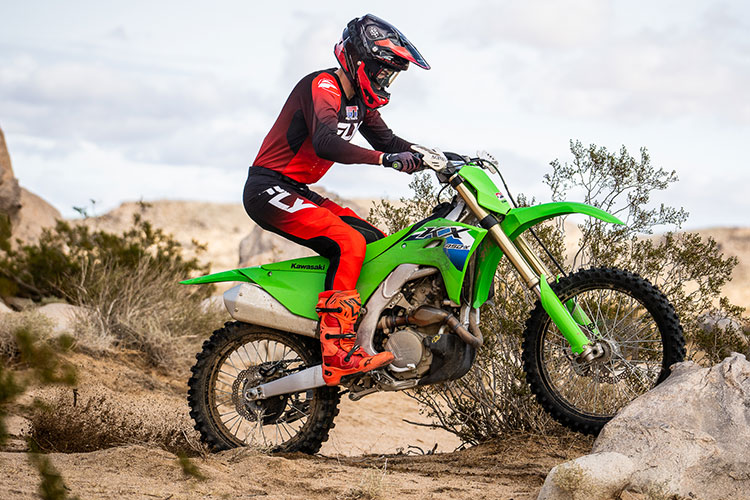
The front end is susceptible to diving under hard braking and through bigger bumps, but it’s more controlled than before and offers more comfort and compliance in the small bumps. Out back we have similar feelings, as the rear can wallow and move through the stroke more than we’d like in bigger whoops, but it tracks straight and drives through square edge holes and smaller acceleration chop. Overall, the bike is more balanced and controlled than before.
A couple smaller setup points we made with last year’s bike and will soon make with this bike is dropping the forks to flush in the clamps and running a one-link longer chain to get the axle further back in the swingarm. The flush fork height adds stability and helps “stiffen” up the fork for us on the west coast. While we do this with stock suspension, it’s a setup point we keep when going back to re-valve suspension as well. Likewise, the longer chain helps add even more stability (both of these that worked well on the 2023- bike as well) and smoothens out the action of the shock a bit, working with more leverage this way. We ran sag at 106-108 depending on the rider, and clicked the compression in a few clicks on each end as needed for higher speeds.

In the chassis department, we still like how well the KX handles. The KX still boasts more bump compliance and comfort than most bikes. However, the whole bike feels drastically lighter and is more maneuverable, despite a slightly heavier scale weight than the 2023-. A lot of the new bikes are going too stiff and rigid in the chassis department to accommodate for Supercross and the top 0.05% of riders in the world, but the general public suffers as a result. Kawasaki kept things in check and we don’t feel they went too far in the wrong direction with this bike. Does it offer the same stability as the old bike? No. But it isn’t all that far off and it picked up greatly in so many areas that the juice is worth the squeeze in most instances.
Overall, we feel Kawasaki is in a good place with this bike. As an off-road platform, the bike is easy to ride with a smooth motor that is suitable to real off-road riding (yet still has potential to be opened up if preferred), a good suspension baseline with capable components, and a chassis that shares a lot of its positive attributes from before, but picks up some new ones in the process. Of course, we can’t skimp over the fact that a large tank, handguards, and a skid plate all don’t come off the showroom floor, but that’s been the case for a few years now. At the end of the day, those are small items that are easily fixed/replaced – a good base of a bike is more difficult to overcome and the KX has that on lock.